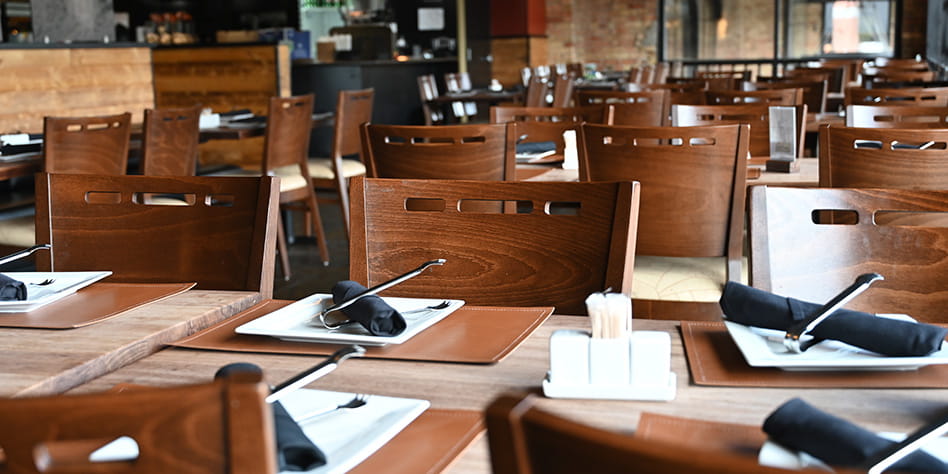
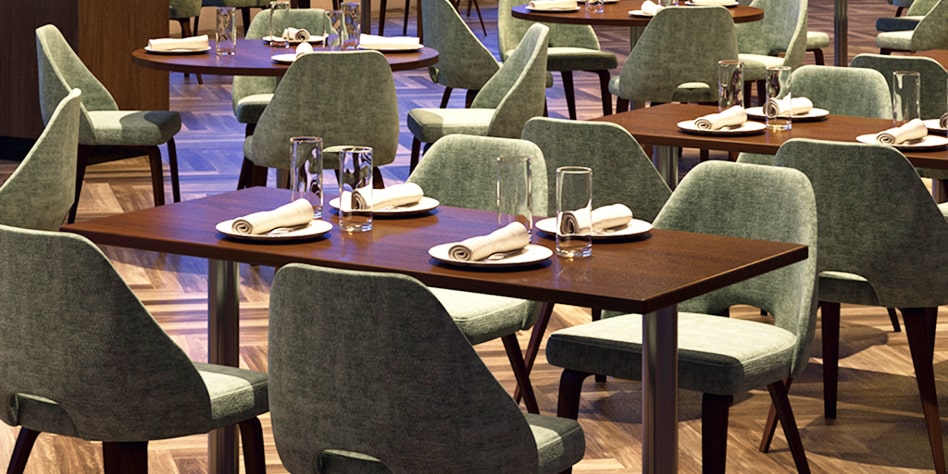
The best restaurant layout is a careful balance of comfort, accessibility, and design. These elements lay the ideal foundation for serving diverse customer needs.
Establishment owners face the challenge of how to use restaurant booths versus table setups to maximize the space, while providing the versatility, comfort, and optimal dining experience guests are looking for.
We’ll explore the strategic advantages of restaurant booths vs. table arrangements, the practical realities of accessibility requirements, and how modern hybrid solutions deliver the best of both worlds.
Restaurant Booths vs. Tables: Why Most Restaurants Need Both
While federal regulations impose certain accessibility requirements on restaurants through the Americans with Disabilities Act (ADA), flourishing establishments already know that serving the customer’s broad range of needs is fundamental to success.
About ADA Compliance for Restaurants
If your restaurant or café has over 20 tables and you’re located in the USA, you are required to comply with ADA requirements. The ADA first established accessibility rules to accommodate easy wheelchair access in restaurants in 1990. According to the most recent updates, at least 5% of tables or dining counters need to be wheelchair accessible.1 So, for a restaurant of 40 tables, 2 tables must be ADA compliant. If you have 20 or fewer tables, at least one must be wheelchair accessible. Bar seating is computed separately. At least 5% (or 1 out of 20) bar seats must be at a lower height and be wheelchair accessible.
In order to meet the wheelchair accessibility requirement, an ADA table must have a clear space of at least 30″ x 48″ to allow for a wheelchair to roll up to it, with 30″ being the width between any table legs or supports, and 48″ being the depth. These accessible tables must be at a height of 28–34″ (710 mm to 865 mm) to provide for knee clearance. In addition, you need to have a wide-open clearance between tables of at least 36″ to allow for wheelchairs to navigate your dining area and make their way to the ADA table(s).
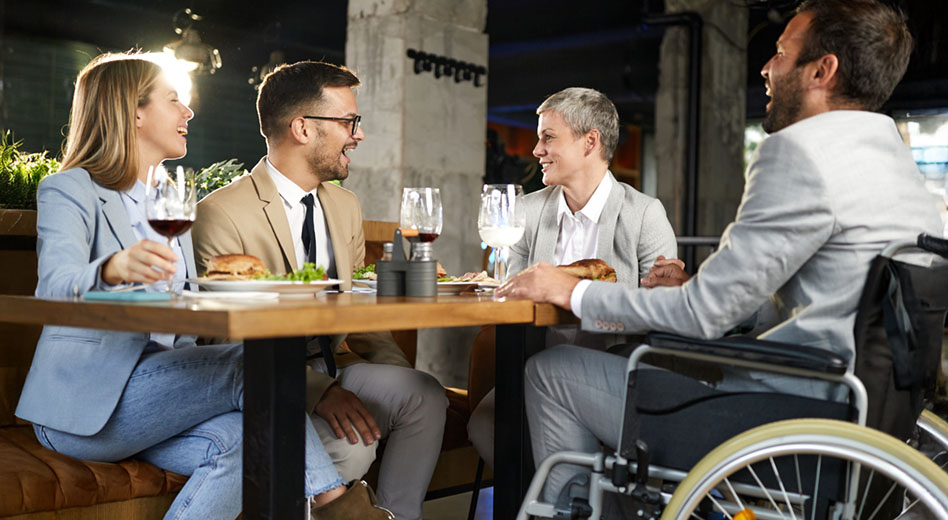
Adhering to these standards can be difficult with ordinary restaurant furniture. A table with a standard pedestal base will usually not allow enough clearance for a wheelchair. Instead, opt for accessible table bases like our 2-Prong End Table Base, a T-style base, or a bolt-down table base that will allow enough space for one or more wheelchairs.
Compliance overlaps with the everyday realities of serving diverse customers. Families come with guests of every age, from toddlers requiring highchairs to the elderly who may need the easiest seating access available.
While many younger diners will prefer the intimacy and coziness of booths, booth seating cannot serve the athlete recovering from a knee surgery, individuals with wheelchairs or other mobility devices, or individuals with back or hip problems, which may make scooting across the bench painful. In addition, guests in semi-formal attire may find it difficult or awkward to scoot along a booth bench, which is why booths are considered more casual than chairs. Parents may find that soft booth cushions aren’t ideal for securing a child’s booster seat. Highchairs placed at a booth’s end can present a tripping hazard and block access for staff and guests.
Multiple seating options accommodate for every party and their needs, meeting every dinner party’s needs.
The Appeal of Booth Seating
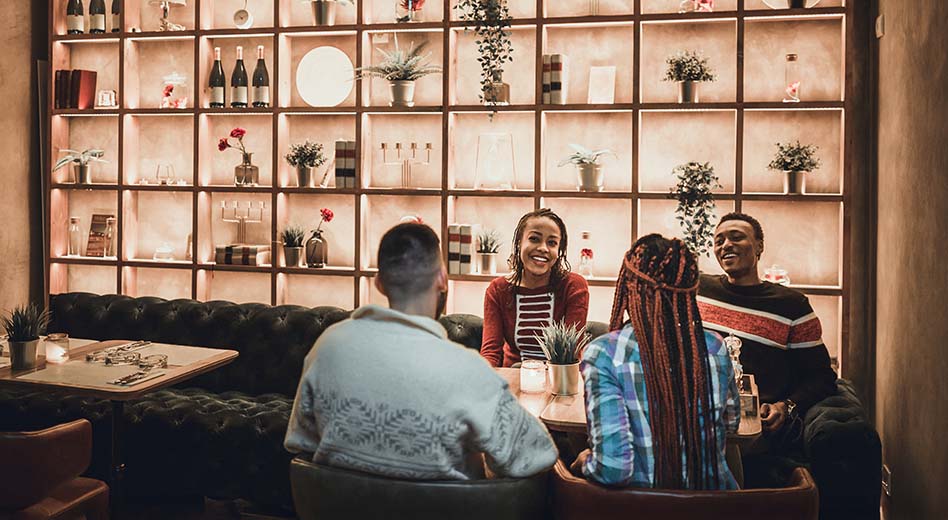
Many diners instinctively gravitate toward booth seating when given the choice. There’s a unique draw to the intimate atmosphere that these semi-enclosed spaces provide. As an added bonus, booth seating is usually space-efficient, allowing restaurants to seat guests more densely while offering more privacy.
- Double booths, which feature bench seating on both sides, are the most common type of restaurant booth seating. These booths can be comfortable and space-efficient, but they aren’t ADA compliant and may not work for families needing highchairs or booster seats.
- Wall benches (often called banquette seating) offer padded bench seating on one side of the table and chairs on the opposite side. This type of booth is more flexible than most booth seating, even if the tables are permanently installed in the wall or mounted in the floor, because the chairs can be moved around to accommodate different groups or removed to make room for guests in wheelchairs.
- L-shaped and corner booths are a space-efficient way of using corners in a dining area, where two walls join. These booths offer padded bench seating around all or most of the table. Guests often like these booths because they offer a high degree of privacy.
- High-backed privacy booths have bench seating on each side of the table. This type of booth generally has a backrest that is taller than guests’ heads and may even reach the ceiling. High-backed privacy booths can be placed against walls or grouped together to form an island in the center of a dining area. The high back gives more privacy to guests and also reduces noise levels, creating a more intimate dining experience.
Booth seating can create a natural barrier from surrounding conversations and foot traffic, offering a sense of separation that transforms a meal into a more personal experience. This makes booths particularly appealing for couples out on a date, confidential business discussions, or family gatherings where guests want to feel settled and undisturbed.
A spacious booth environment can invite longer stays, creating the cozy atmosphere that many customers associate with memorable dining experiences.
The Flexibility of Tables and Chairs
Tables and chairs can be arranged to provide intimate two-top seating or grouped together to accommodate large parties. They provide the adaptability modern restaurants require. Because tables and chairs are so flexible, they help owners maximize revenue.
This flexibility is beneficial for accommodating different party sizes and minimizing empty tables. If you’re researching how many people can sit at a restaurant table, bear in mind that it’ll be different for the coffee and breakfast rush at a casual café than from a fine-dining experience. In a cafeteria or café setting, 18-20″ per person of table edge is acceptable, but for fine dining, 26-28″ is the standard amount of table space needed per person. For spaces that need to accommodate wheelchairs, 30″ of table space is required according to ADA guidelines.
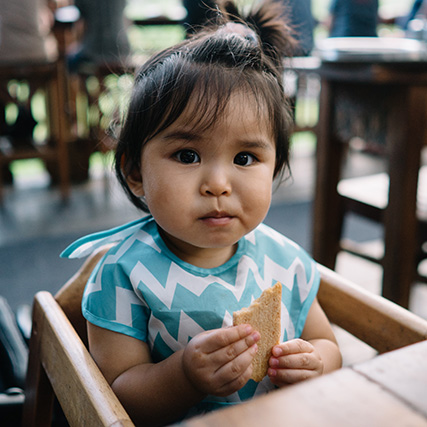
In the case of accessibility and flexibility, table and chair seating is ideal for formal environments, for those who use wheelchairs or mobility devices, and for families with young children who need boosters or highchairs.
Popular trends in dining—from communal to fast casual and family-style service—provide restaurants the opportunity to try new themes and configurations. Tables and chairs are easy to reconfigure to adapt to different party sizes, business groups, and seasonal changes.
Designing for Accessibility and Comfort
Creating truly accessible restaurant spaces starts with understanding the real-world challenges that diverse customers face when dining out.
Families with toddlers require highchairs that position safely alongside tables, while pregnant women may need seating they can access comfortably. Elderly guests using walkers benefit from open approaches that don’t require navigating confined spaces or sliding along a bench. Though these customers might prefer the intimate, cozy privacy that booths offer, their practical needs often make booth seating challenging or impossible.
These are the everyday dining situations every restaurant should plan for. The spatial requirements for maneuvering mobility aids like wheelchairs, walkers, canes, or crutches demand open access that extends beyond the comforts of booth seating.
Booth configurations present particular challenges for families attempting to secure booster seats on soft cushion surfaces with gaps between sections, creating instability that table and chair seating eliminates. The confined entry and exit requirements of booth seating create barriers for many individuals with mobility challenges or health concerns.
Smart accessibility design is about bringing comfort and compliance together. When restaurants prioritize accessible seating distributed throughout their dining areas, they create environments where every guest enjoys options that are best suited to their desired dining experience.
Hybrid Options
Restaurant owners don’t have to use all booths or all table and chair setups. Many modern restaurants benefit from offering seating that includes some booths and some tables and chairs. This way, all guests can be comfortably seated in a space that meets their needs.
In addition, some restaurants utilize padded benches to create a booth-like feel that’s still ADA compliant. Upholstered benches deliver booth-like intimacy with table-style adaptability. One side of the table can have chairs drawn up to it, while the other has a bench.
For example, MityLite’s Palmanova Arm Bench exemplifies this hybrid approach. Its elegantly sloped back and fully upholstered design create the cozy, enclosed feeling that draws diners to booths. Restaurants can dial in the exact level of visual separation and comfort their concept requires, and guests experience the privacy and comfort of booth seating—minus the barriers.
The Palmanova offers three armrest styles, over 1,000 fabric options, and 22 wood stain choices, making it easy for restaurant owners to create bespoke furniture solutions aligned to their brand aesthetic. Lightweight yet sturdy, the Palmanova bench can offer many of the advantages of booth seating with the flexibility of chair seating.
For fast casual and communal dining trends, benches can be used as shared seating that balances efficiency with experience. They accommodate quick reconfigurations during busy periods while supporting the social, community-focused atmospheres today’s diners increasingly seek.
Benches paired with tables can reconfigure for different party sizes, special events, and accessibility needs. The result is furniture that adapts to service demands, without compromise.
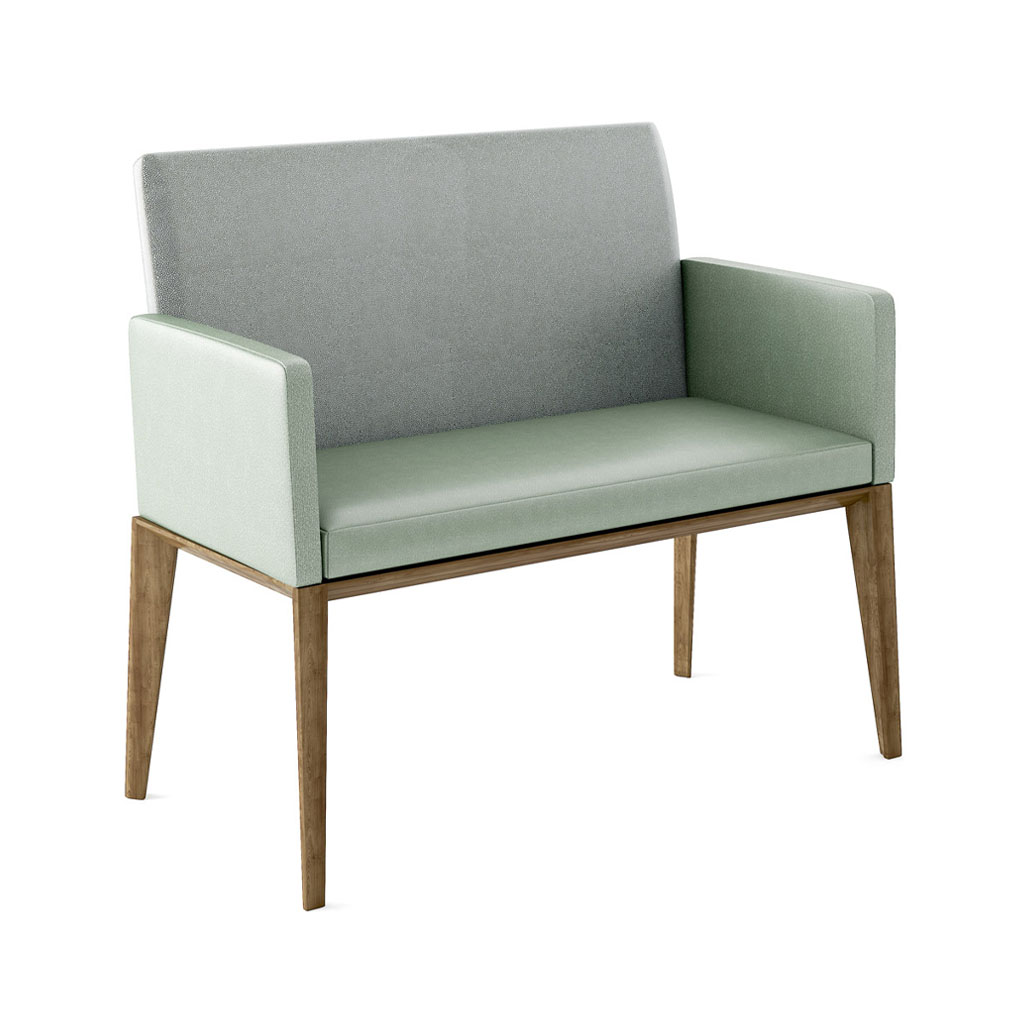
Subtle Sloped Back
A gentle angle that enhances comfort and elevates the silhouette.
Hardwood Legs
Durable European beechwood delivers strength and refined style.
Cushion & Webbing
Plush cushioning over supportive webbing for lasting comfort.
Arm Style Options
Choose from Straight, Sloped, or Arched arms to match any aesthetic.
Adapting Seating Layout Throughout the Day
The emerging trend toward experiential dining demands furniture that supports diverse activities within the same space throughout the day. A restaurant can vary the dining experience throughout the day for morning, noon, and nighttime services.
Breakfast could be presented as casual service, with communal seating that accommodates a packed restaurant.
The same restaurant can change the layout to accommodate quick-service, grab-and-go lunch menu items as well as small table seating areas for guests who have the time to linger over lunch.
In the evening, the mode can shift by folding up some of the tables to create a layout that gives more space between tables, encouraging longer stays, multiple-course menus, and higher priced menu items.
Design Your Ideal Dining Environment with MityLite
MityLite delivers commercial-grade tables, chairs, and benches for restaurants of virtually every theme, style, and size. Our furniture is built to withstand frequent use, spills, and the daily demands of a successful restaurant.
From stackable seating to barstools, upholstered benches to customizable table systems, we supply restaurant owners with the flexibility and design options to make a statement, maintain customer comfort, and adapt to changes throughout the day.
References
- 2010 ADA Standards for Accessible Design, ADA.gov, U.S. Department of Justice Civil Rights Division. Section 226 Dining Surfaces and Work Surfaces, 226.1 General. https://www.access-board.gov/files/ada/ADA-Standards.pdf

Explore our restaurant seating options
Contact us to speak with one of our restaurant furniture specialists today.
Products Featured in This Article
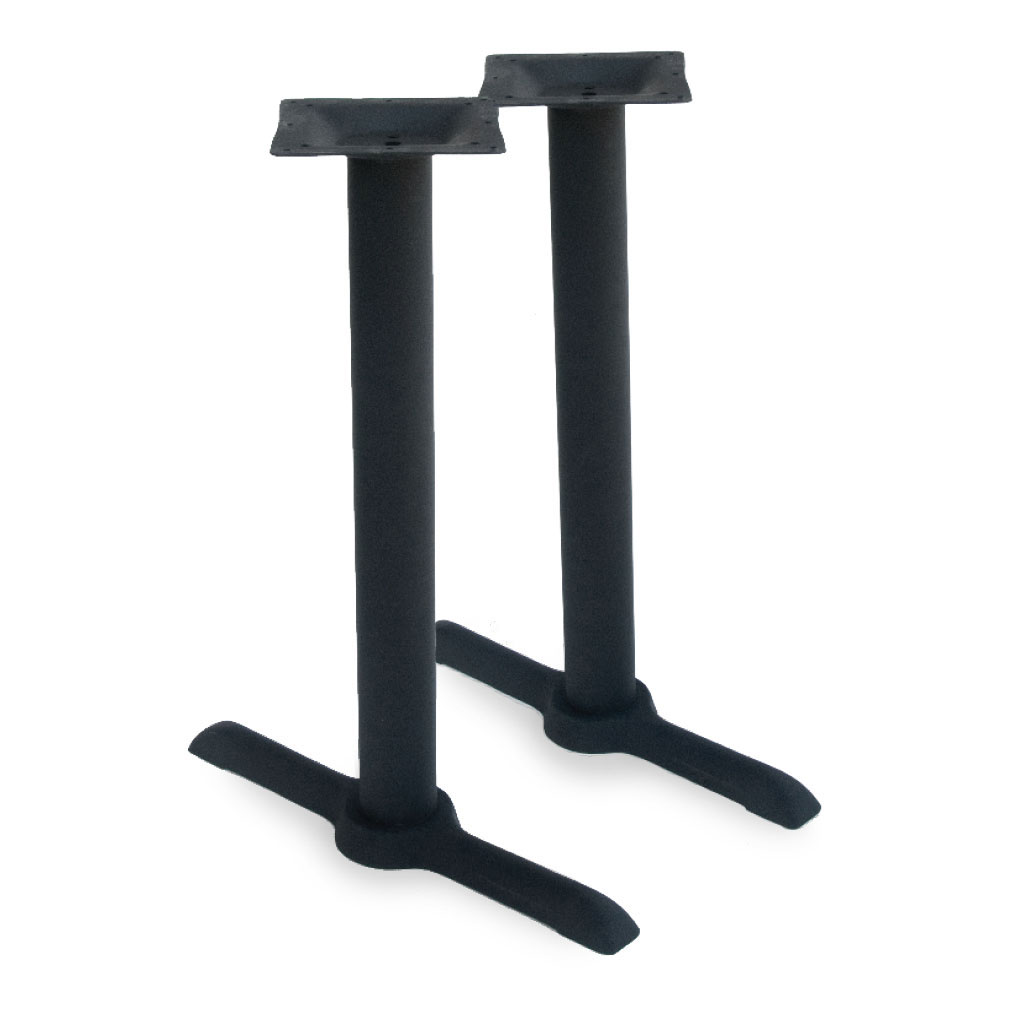
2-Prong End Table Base
2 Table Base Sizes, 2 Table Heights
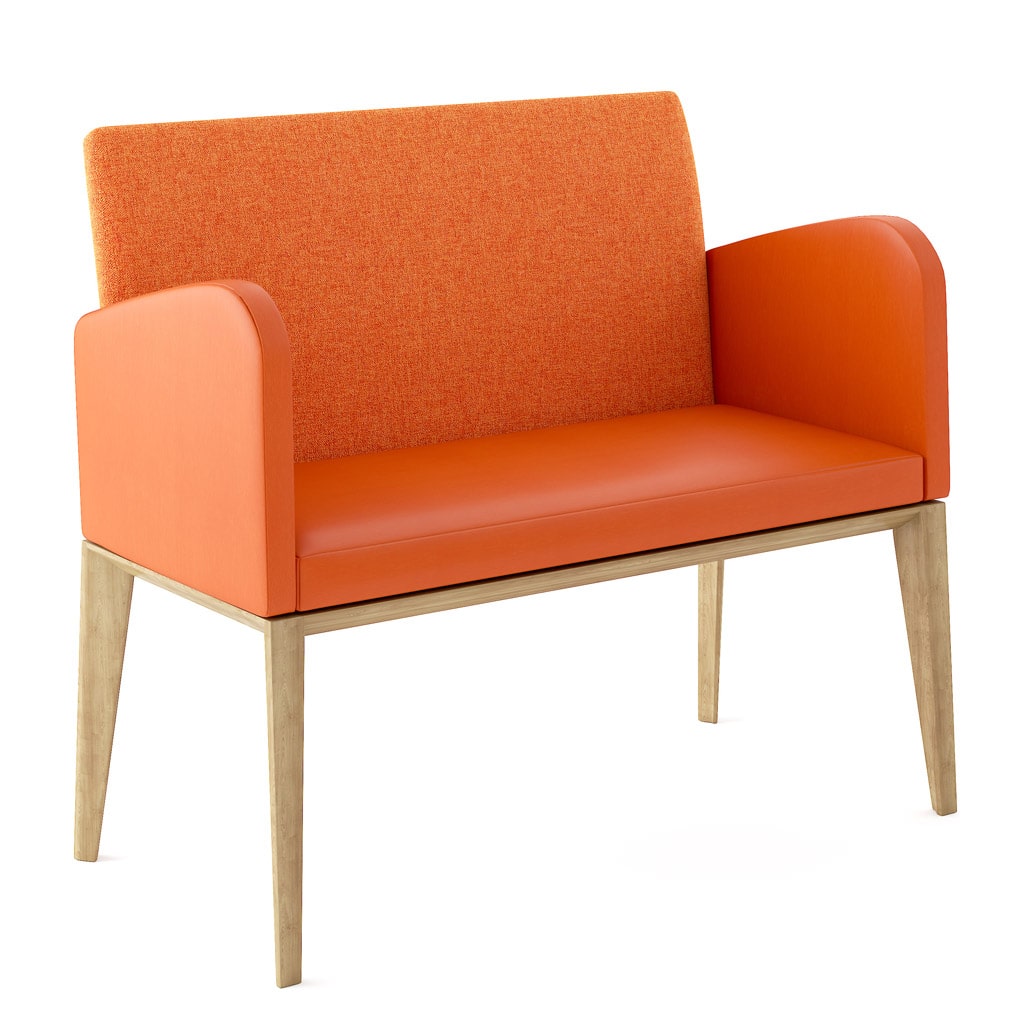
Palmanova Arm Bench
3 Arm Styles