A Moment That Happens Every Day
The comforting scent of freshly baked rolls wafts through the air as a senior living center resident approaches her dining room chair.
She pauses for just a second, reaching for the armrest. She turns, positions herself, and begins to sit. The chair does not budge when she leans on it. The seat meets her at the right height. The cushion gives slightly but refuses to sink. Her feet stay flat on the floor, firmly planted. Nothing catches or shifts.
When furniture for senior living is designed well, it functions without calling attention to itself. It supports, steadies, and guides movement in ways people rarely notice. But to MityLite, even the smallest detail matters.
In a senior community, daily life happens primarily indoors. The difference between a safe movement and a fall often comes down to the immediate environment.
Why Furniture for Senior Living Plays a Key Role in Preventing Falls
In many cases, the chairs and tables within arm’s reach play a direct role in whether that resident stays steady or loses her balance. In senior communities, the right furniture supports mobility and reduces risk. The wrong furniture introduces uncertainty at the exact moment she needs stability most.
Most Falls Happen Indoors and at Home
“Research shows that 71.6% of fall-related emergency department visits come from falls that happen indoors. Even more telling, 79.2% of those falls occur at home, with common locations including the bedroom, bathroom, and stairs”.1 Senior living communities know these statistics well and put preventative strategies in place to avoid the worst possible scenario.
Dr. Sandra Petersen, a member of the American Seniors Housing Association (ASHA) Advisory Board, and Senior VP of Health and Wellness at Pegasus Senior Living said, “What makes senior living communities so effective in preventing falls in aging adults is that they bring all the right elements together . . . to lower those risks in a way that most families simply can’t manage at home”.2
One of those elements is the selection of safely designed furniture. The furniture in these senior living communities is different than most homes. The pieces selected are than a design choice. They are part of an intentional prevention strategy.
Why Armchairs Support Movement
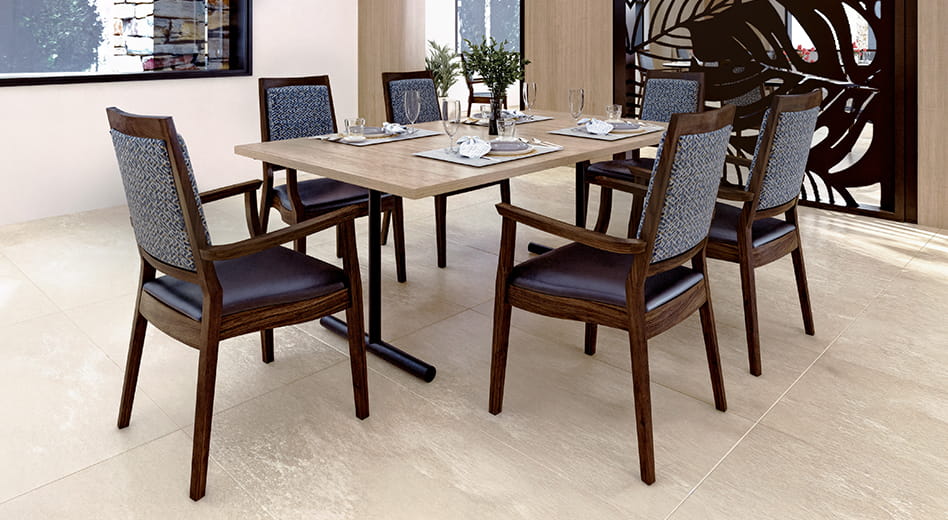
MityLite manufactures Holsag armchairs that combine a warm, inviting look with dependable daily performance. Every detail creates a sense of stability that residents can feel the moment they reach for the chair.
In an assisted living center, a chair should perform as expected. When a resident begins to sit or stand, even a small wiggle can lead to hesitation or loss of balance. The Holsag line gives senior residents three different armchair options depending on their needs: stationary chairs (without wheels), chairs with inline wheels, and a third option that employs casters. Holsag constructs all three armchairs using solid construction, so all chairs remain grounded and predictable.
The arms of each chair play an equally important role. They provide a natural place to grip and apply pressure when lowering into a seat or rising to stand. This added support reduces strain and gives residents more control over their movement.
The chair design supports balance in a subtle but important way. Residents can plant their feet firmly on the floor without obstruction. We avoid awkward base shapes or interfering chair legs that force unnatural positioning. The chair works with the body, not against it.
The cushion supports the body without allowing it to sink too deeply. That means residents can sit comfortably in beautiful, commercial-grade furniture, and still maintain the ability to stand easily.
When Wheels Make a Difference
Chairs with wheels can support mobility and independence in senior living settings, but they must be used carefully. In dining or activity spaces, controlled movement helps to reposition chairs or assist residents at the table. The movement must be predictable and easy to manage. When a chair moves too freely, it shifts at the worst possible moment and increases the risk of a fall.
The Holsag line offers two different types of wheels: casters and inline wheels. Casters allow full, multi-directional movement. This works well in clinical settings where the staff transports the residents. The 360-degree rotation allows the chair to swivel in any direction and simplifies movement.
Inline wheels offer a more controlled solution. They guide movement in a straight line and often engage only when the chair is tilted or moved deliberately. During normal use, the chair stays grounded and stable. This balance between movement and control helps reduce risk while still allowing flexibility for staff.
In communal spaces where safety matters most, the way a chair moves can make a meaningful difference. Each facility must choose the type of movement that best fits their needs.
How Tables Contribute to a Safer Environment
Tables often go unmentioned in conversations about fall prevention, but they play a crucial role in how residents move through a space:
MityLite tables provide a strong, reliable surface that residents can use for light support when needed. Whether someone steadies themselves while sitting down or adjusting their position, the table remains stable.
Let’s talk about what happens underneath the table. Clear, thoughtful leg design meets ADA and accessibility requirements. It allows residents to position their feet naturally and move chairs in and out without obstruction. This reduces the risk of catching a foot or misjudging space, which are common causes of minor stumbles or falls.
When chair and table designs work together, the entire room feels more intuitive. Residents do not have to second-guess distances or movements. That sense of predictability builds confidence over time.
More Than Just a Stylish Design
Holsag furniture infuses senior living communities with designs that make every room feel more like home. The cheerful upholstery and beautiful beechwood frames soften the setting. The classic lines of chairs and tables mask the durability and sturdiness of each handcrafted piece. Rich finishes tie the room together.
But that is not all. The furniture is meant to keep residents safe in other ways. Because the elderly population suffers from vulnerable or compromised immune systems, furniture cleanability is a must. The Holsag line includes smooth surfaces that can disinfect easily and keep germs contained. The materials stand up to repeated sanitizing without deteriorating or damaging.
When caregivers promise to keep residents safe, furniture choice comes down to subtle details. A well-designed furnishing can be both beautiful and functional.

Reducing the Strain on Caregivers
Caregiving is physical work. The intentional design choices in furniture either add to that strain or reduce it over time.
Lightweight, sturdy chairs allow caregivers to transition seating without excessive effort. Open space beneath chairs and tables allows caregivers to step in closer when assisting, which improves posture and reduces awkward twists or lifts. Smooth edges and balanced construction make it easier to move furniture safely through a room.
Furniture made from durable materials holds up despite daily use and reduces the need for frequent adjustments, repairs, or replacements. This consistency helps caregivers maintain a steady routine without added interruptions.
When furniture supports the work of caregivers, it creates an environment where both residents and staff move through the day with greater ease.
The Design Details That Help Prevent the Unimaginable
Fall prevention often comes down to small details. Well-crafted furniture supports the body through every stage of movement, from sitting down to standing up and everything in between.
The most effective furniture for senior communities must have:
- Stability that prevents shifting or rolling
- Strong arm support that helps guide safe transitions
- Secure grip points that feel natural to use
- Durable construction that supports full body weight without question
- Open space beneath seating that allows proper foot placement
- Balanced proportions that support posture and center of gravity
- Cushions that provide comfort without trapping the user
- Seat heights that make sitting and standing feel smooth and controlled
Each of these elements may seem simple on its own, but together they create an environment that actively reduces risk.
Safer Spaces Start with Smarter Choices
The senior living center resident dabs her lips with the napkin and scoots away from the dining table. Her hands press firmly on the arms of the reliable chair. Her body rises in one controlled motion. She does not need to rock to get up or signal someone for help. That is the point.
Across the room, the same quiet scenarios repeat. A weathered hand grips a table for balance. Chairs tuck neatly under the table without snagging the legs of a walker. At MityLite, we have one goal in mind: create furniture that people can rely on without thinking twice.
The right furniture does more than fill a room. It helps prevent falls.

Ready for a quote?
Chat with a dedicated sales rep today!
Sources
- Moreland, Briana L., Ramakrishna Kakara, Yara K. Haddad, Iju Shakya, and Gwen Bergen. 2020. “A Descriptive Analysis of Location of Older Adult Falls That Resulted in Emergency Department Visits in the United States, 2015.” American Journal of Lifestyle Medicine 15 (6): 155982762094218. https://doi.org/10.1177/1559827620942187.
- Fountain Digital. 2025. “Senior Living Fall Prevention | Where You Live Matters.” Where You Live Matters. July 29, 2025. https://www.whereyoulivematters.org/resources/senior-fall-prevention/.